Hotel Dinnerware & Glassware Buying Guide
Hotel dinnerware and glassware guide: porcelain vs bone china, vitrified hotelware, tempered glass, durability, and how to buy by service style.
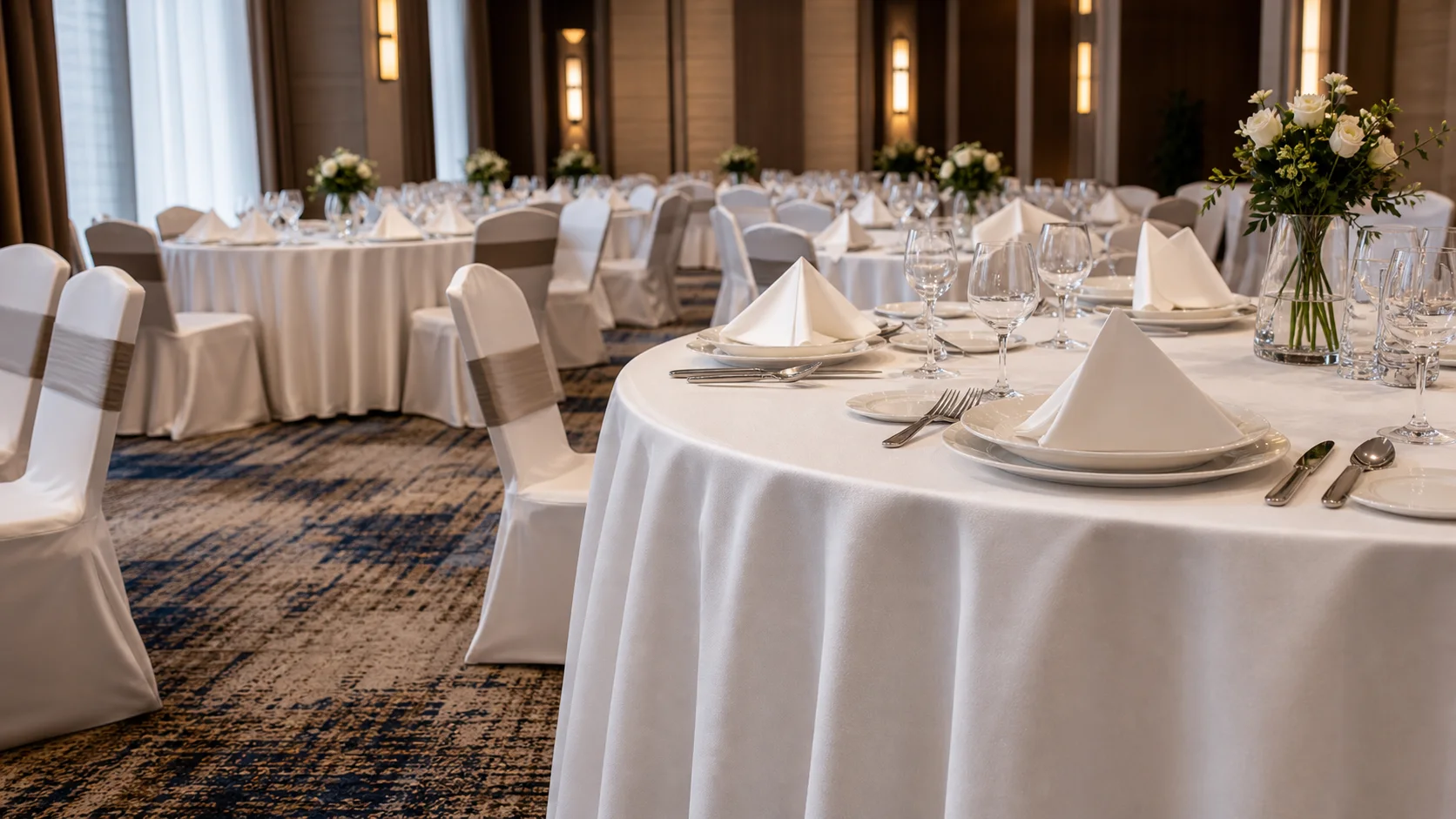
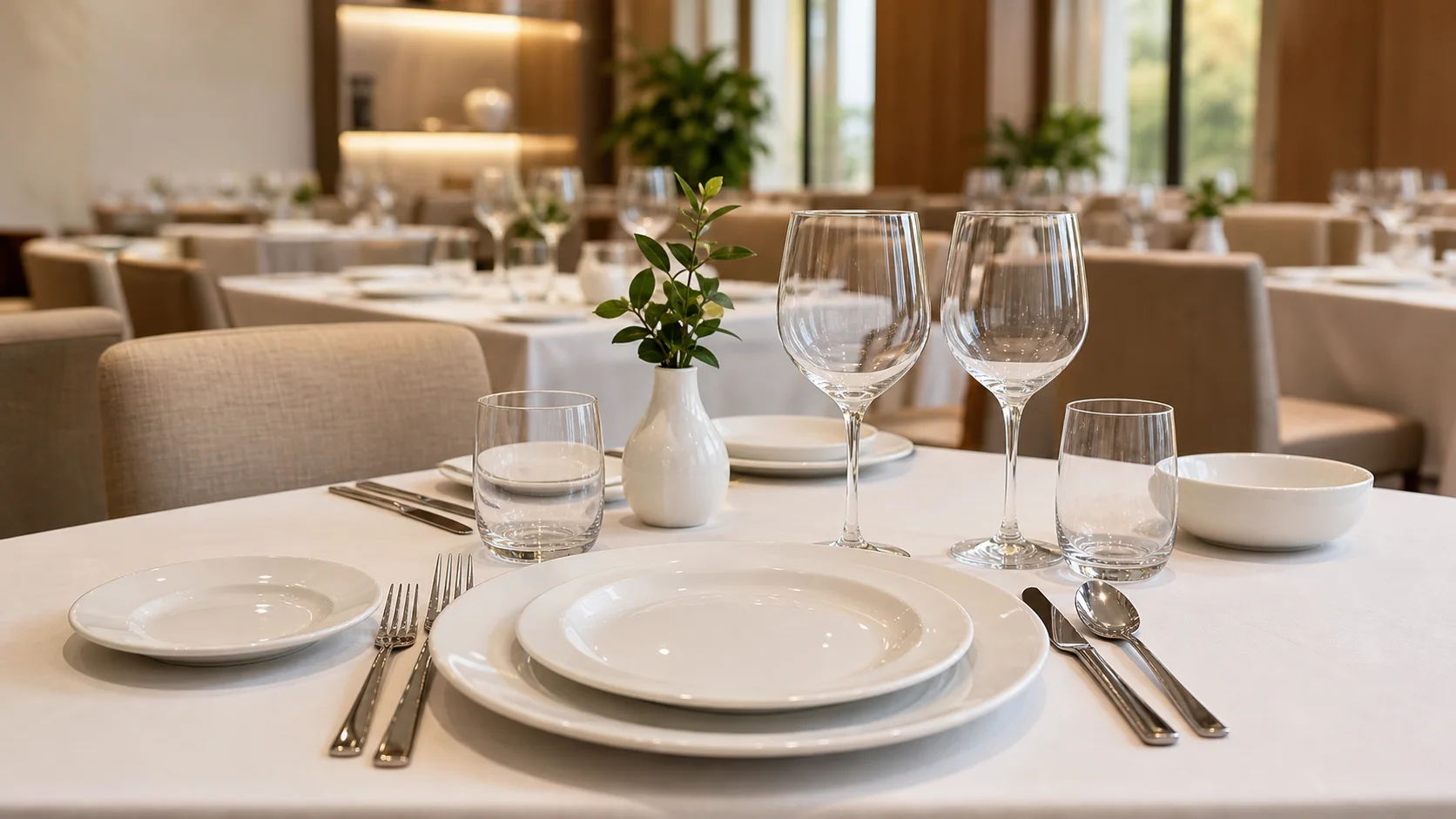
Materials and operations, shown together.
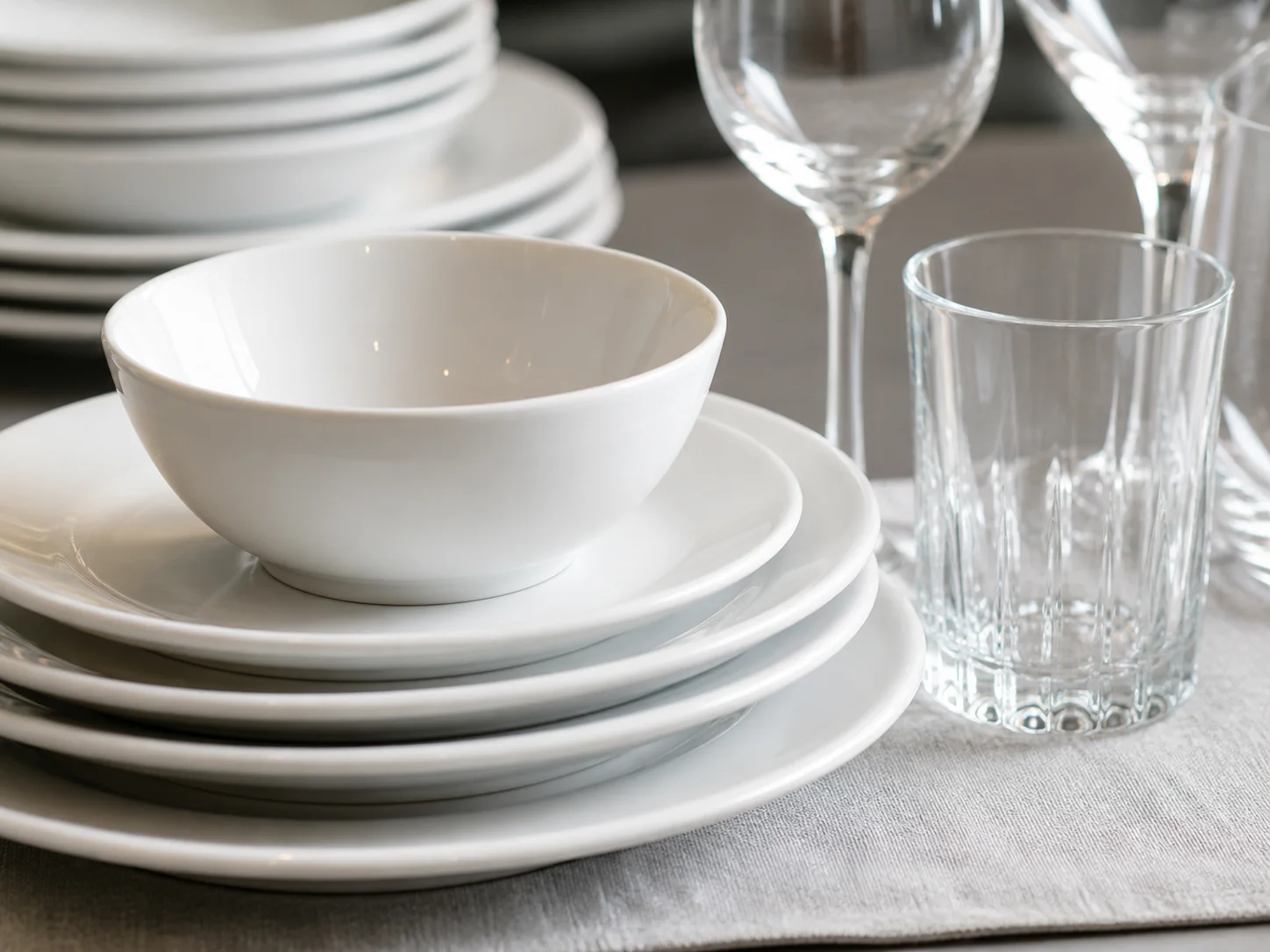
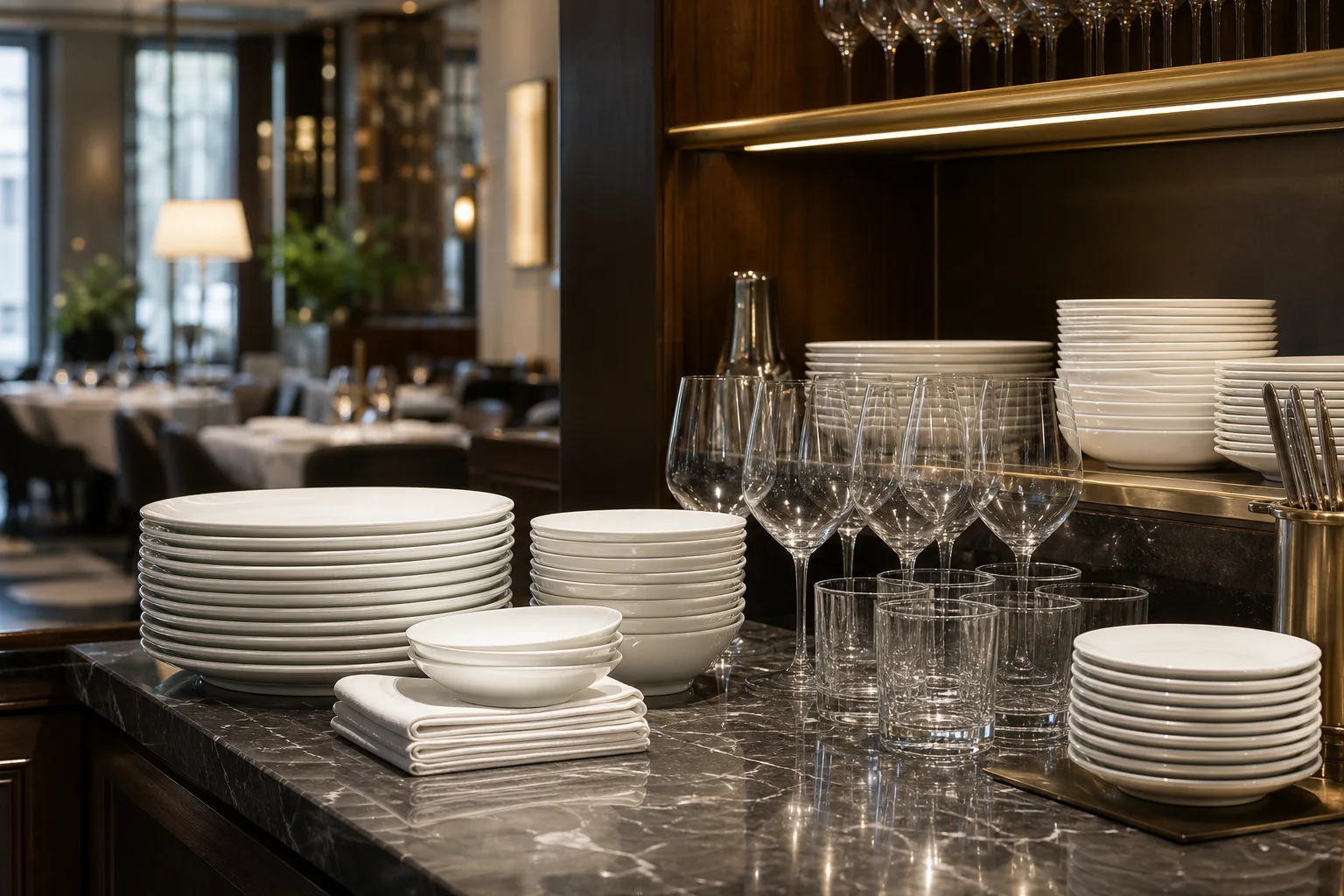
Product detail and back-of-house context help connect each specification choice to how the item looks, launders, stores, or survives service.
Hotel Dinnerware & Glassware Buying Guide: Materials & Durability
Tabletop is where your food and beverage program meets the guest’s hand. Get the dinnerware and glassware right and it reads as quality, survives thousands of wash cycles, and keeps replacement costs predictable across every outlet. Get it wrong and you’ll see the rims chip within weeks, watch a glass crack under thermal shock at the bar, and end up explaining why three “white” plates on the same table don’t match because a pattern got discontinued.
This guide walks through the materials that actually drive those outcomes. On the plate that means porcelain, bone china, and vitrified hotelware. On the glass it means soda-lime, tempered, and crystalline. I’ll translate each one into procurement decisions you can defend on a spreadsheet, because what you’re really buying is durability per dollar, brand consistency across a portfolio, and tableware matched to how each space serves.
Key takeaways
- Vitrified hotelware (vitrified china/stoneware) is the workhorse for high-volume service: dense, low-porosity ceramic with rolled edges and strong chip resistance, often backed by an edge-chip warranty.
- Bone china gives you the thinnest, whitest, most translucent look for fine dining. It’s surprisingly strong for its weight, and you pay for that.
- For glassware, fully tempered (toughened) glass resists chips and thermal shock far better than annealed soda-lime, so it’s the default for banquets, pool bars, and all-day dining.
- Buy for total cost of breakage, not unit price. Stackability, open-stock replacement availability, and pattern longevity drive the real number.
- Confirm food-safety compliance (lead and cadmium limits) and match every item to its service style before you lock in a chain-wide standard.
Hotel Dinnerware Materials Explained
All ceramic dinnerware starts as clay that gets shaped and fired at high temperature, but the body composition and the firing process decide strength, weight, translucency, and price. Here are the four categories you’ll weigh most often.
Porcelain
Porcelain is a fine-grained ceramic fired at high temperatures (typically around 1,200 to 1,400°C) until the body partially vitrifies, meaning the material fuses into a glass-like, low-porosity state. That density is what makes porcelain hard, non-absorbent, and fit for daily commercial use. Good commercial porcelain pairs a clean white face with solid mechanical strength, which is why you’ll find it across upscale and mid-market hotel restaurants alike.
Bone China
Bone china includes bone ash in the body (traditionally a high proportion), and that’s what produces the exceptionally white, translucent, lightweight result. It feels delicate, but well-made bone china is mechanically strong for how thin it is, and it holds the refined look fine-dining rooms are after. It carries the highest price of the common dinnerware types, so most properties reserve it for signature restaurants, suites, and high-end banqueting rather than throwing it into rough all-day service.
New Bone China
New bone china is a more affordable stand-in that mimics the bright whiteness and lighter feel of traditional bone china using different body chemistry (with no bone ash, or a reduced amount). It sits between standard porcelain and the real thing: more elegant than basic hotelware, easier on the budget than genuine bone china. If you want a refined table without fine-dining pricing, this is the usual compromise.
Vitrified Hotelware (Vitrified China / Stoneware)
This is the durability category. Vitrification means firing the ceramic body until it turns dense and glass-like with very low porosity, so it absorbs almost no water and shrugs off staining, crazing, and mechanical damage. Vitrified hotelware (you’ll see it labeled “vitrified china,” “hotel stoneware,” or “ironstone”) is built for foodservice abuse: heavy banqueting, conveyor dishwashers, stacking, and constant handling.
Two features tell you a vitrified range is worth buying:
- Rolled or reinforced edges. A thickened, rolled rim spreads impact and cuts edge chipping dramatically, and the edge is the most common failure point on any plate.
- Edge-chip warranties. Because the durability here is engineered and measurable, many commercial vitrified ranges carry a manufacturer warranty against edge chipping for a set period (commonly one to several years on the rim). Treat that as a quality signal, but read the terms. Coverage usually applies to chips, not to breakage from misuse.
Glazes, Decoration, and Stackability
The glaze is the glassy coating fused onto the ceramic surface. How the decoration goes on decides how long it survives commercial washing:
- In-glaze (and under-glaze) decoration is fired into or beneath the glaze layer, so the pattern is protected and far more resistant to fading, scratching, and detergent wear. For hotel use, this is the durable choice.
- On-glaze (over-glaze) decoration sits on top of the fired glaze. It allows richer colors and metallic effects (think gold banding), but it wears faster and takes more damage from abrasive dishwashing. Keep delicate banded or gilded pieces for lower-rotation, higher-touch service.
Stackability is the kind of procurement detail that pays off every single shift. Plates and bowls that nest tightly save shelf and trolley space, reduce edge-to-edge contact damage, and speed up service setup. When you standardize a range, confirm the stacking heights and ask whether stacking lugs or felt separators are recommended to protect glazed surfaces in storage.
Dinnerware Material Comparison
| Material | Look & feel | Durability | Relative cost | Best fit |
|---|---|---|---|---|
| Vitrified hotelware | Sturdy, clean white, often thicker rim | Highest impact/chip resistance; rolled edges; warranty-backed | $ | Banquets, buffets, all-day dining, high-volume outlets |
| Porcelain | Refined white, moderate weight | Strong, low porosity; good daily durability | $$ | Upscale restaurants, room service, broad use |
| New bone china | Bright white, lighter, semi-translucent | Good, but more delicate than vitrified | $$ | Elevated dining on a budget |
| Bone china | Whitest, thinnest, translucent, premium | Strong for its weight but chips show easily | $$$ | Fine dining, signature rooms, VIP banqueting |
Microwave and dishwasher note: Most quality commercial ceramic is dishwasher-safe. What limits microwave and wash performance is usually the decoration, not the body. Metallic banding (gold or platinum) isn’t microwave-safe and degrades faster in aggressive wash cycles. Always confirm the dishwasher and microwave ratings per pattern, especially on decorated lines.
Hotel Glassware Materials Explained
Glassware fails in two ways dinnerware doesn’t: it shatters from impact and it cracks from thermal shock, the sudden temperature change you get when ice water hits a glass that just came out of a warm dishwasher. Material and rim treatment are what protect against both.
Soda-Lime Glass (Annealed)
Standard, economical glass made from soda, lime, and silica. Annealed soda-lime is the baseline for cheap tumblers and stemware, but un-toughened it’s the most prone to chipping and thermal-shock breakage. It’ll do for low-volume or back-of-house use. Once you factor in breakage replacement in a busy outlet, though, it stops being the best value.
Fully Tempered (Toughened) Glass
Tempering puts the glass surface under compression through controlled rapid cooling, and that makes it far more resistant to impact, chipping, and thermal shock. Fully toughened glassware is the high-volume workhorse. It takes banquet handling, fast dishwasher cycles, and the temperature swings of a busy bar in stride where annealed glass wouldn’t. When tempered glass does fail, it tends to break into smaller, less hazardous fragments instead of long shards. Many commercial ranges also add a tempered or reinforced rim, which matters because the rim is the most chip-prone part of any glass. A strong rim is the single best predictor of how long your glassware lasts.
Crystalline / Crystal Glass (Lead-Free)
“Crystal glass” and “crystalline” refer to glass with added minerals that boost clarity, brilliance, and that satisfying ring, historically achieved with lead oxide. Modern hospitality crystalline is lead-free, using alternatives like titanium or zinc oxide to deliver the clarity and thin, elegant profile of crystal without the lead-safety concerns. It’s the premium pick for fine-dining stemware and signature cocktails, valued for thin, fine-cut rims and sparkle. The trade-off is fragility and cost, so it doesn’t belong in poolside or banquet rotation.
Stemware, Tumblers, and Specialty
- Stemware (wine, champagne, cocktail coupes) is held by the stem to keep the bowl unmarked and the drink temperature stable. Fine-dining programs lean toward thin crystalline; high-rotation venues go for tempered stemware that can take a beating.
- Tumblers (water, highball, rocks, juice) take the most abuse, so they benefit most from fully tempered bodies and rims.
- Specialty glassware (beer, margarita, snifter, latte, shot) should match what’s actually on the menu. Don’t over-buy shapes that rarely turn.
Glassware Type Comparison
| Glass type | Clarity & feel | Durability | Thermal-shock resistance | Best fit |
|---|---|---|---|---|
| Annealed soda-lime | Standard clarity | Lowest | Low | Back-of-house, low-volume, budget |
| Fully tempered (toughened) | Good clarity, sturdier walls | Highest impact/chip resistance | High | Banquets, all-day dining, pool bar, high-volume bars |
| Lead-free crystalline/crystal | Highest brilliance, thin rims | Lower (fragile, premium) | Moderate | Fine-dining stemware, signature cocktails, VIP |
How to Buy: Procurement Criteria That Matter
Once you’ve got the materials straight, the buying decision comes down to a handful of operational factors.
1. Total Cost of Breakage, Not Unit Price
A cheaper plate or glass that chips in three months is the expensive option. Estimate your annual breakage and replacement for each candidate and compare lifetime cost, not the sticker. In a busy outlet, warranty-backed vitrified dinnerware and fully tempered glassware usually win that math even when they cost more up front.
2. Stackability and Storage
Tight-nesting plates, bowls, and stackable glasses save storage, cut in-storage damage, and speed up turnarounds. In a space-constrained property that’s a real operational gain, not a nice-to-have.
3. Replacement and Open-Stock Availability
Confirm that every item is open stock, meaning you can order it individually and restock it reliably, rather than a limited collection that vanishes after one season. Ask suppliers about expected pattern longevity and reorder lead times. Nothing undermines a polished table faster than a guest noticing three slightly different “white” plates.
4. Brand Consistency Across a Chain
For groups and chains, a single tabletop standard keeps every property on-brand and makes central purchasing simpler. Standardize on ranges with proven supply continuity, and look at OEM or custom options if you need a signature look reproduced identically across locations.
5. Match to Service Style
Buy for how each space serves:
- Fine dining: bone china or new bone china, lead-free crystalline stemware, restrained in-glaze or banded decoration.
- All-day dining / restaurants: porcelain or vitrified hotelware, tempered tumblers and stemware.
- Banqueting and conferences: vitrified hotelware with rolled edges, fully toughened banquet glasses, maximum stackability.
- Pool bar and outdoor: fully tempered glass (or approved alternatives where glass is restricted), durable vitrified or melamine-style options wherever breakage risk runs highest.
6. Food-Safety and Compliance
Tableware that touches food has to meet lead and cadmium release limits under the rules that apply to you (for example, FDA limits in the US and EU framework rules on ceramics in contact with food). Reputable commercial dinnerware and lead-free crystalline glassware are formulated to comply, but ask for the documentation or test certificates anyway, especially on decorated or imported lines. For any procurement team, this is non-negotiable due diligence.
FAQ
What is the most durable dinnerware for hotels? Vitrified hotelware (vitrified china or hotel stoneware) is the most durable for high-volume service. Its dense, low-porosity body, rolled reinforced edges, and frequent edge-chip warranties make it the best choice for banquets, buffets, and all-day dining.
Is bone china better than porcelain for hotels? Bone china is whiter, thinner, more translucent, and more expensive, which makes it ideal for fine dining and VIP service. Porcelain is more affordable and durable for everyday use. Most properties run porcelain or vitrified ware broadly and keep bone china for signature outlets.
Why is tempered glassware recommended for hotels? Fully tempered (toughened) glass resists impact, chipping, and thermal shock far better than ordinary annealed glass, and it breaks into smaller, safer fragments. That durability makes it the standard for high-volume bars, banquets, and pool service where breakage costs add up fast.
Is crystal glassware safe for food and drink? Modern hospitality crystalline (crystal) glass is lead-free, using minerals like titanium or zinc oxide instead of lead oxide. It delivers crystal-like clarity and a fine rim without lead-safety concerns, which is why lead-free crystalline is the premium fine-dining choice.
How do I keep tableware consistent across a hotel chain? Standardize on open-stock ranges with proven supply continuity so every item can be reordered individually and matched exactly. For a signature look, use a supplier offering OEM/custom production that can reproduce the same specification across all properties.
Can hotel dinnerware go in the dishwasher and microwave? Most quality commercial ceramic bodies are dishwasher-safe; the limit is usually the decoration. Metallic gold or platinum banding is not microwave-safe and wears faster in aggressive wash cycles. Always confirm the dishwasher and microwave rating for each specific pattern.
A coordinated tabletop, where dinnerware, glassware, and table linen share one design language, is what turns a meal into an experience. If you’re standardizing tableware across outlets or a whole portfolio, a one-stop hotel supplies partner can help you compare materials, request product samples, and build a durable, on-brand specification. Reach out for a catalog or a custom quote to match the right dinnerware and glassware to each of your service styles.
Internal links: hotel-table-linen-guide, hotel-textile-certifications-explained, sustainable-hotel-linen-guide