Hotel Towel Buying Guide: GSM, Cotton & Durability
How to buy hotel towels: GSM ranges by towel type and tier, cotton grades, loop pile, absorbency vs durability, and laundry survivability.
Materials and operations, shown together.
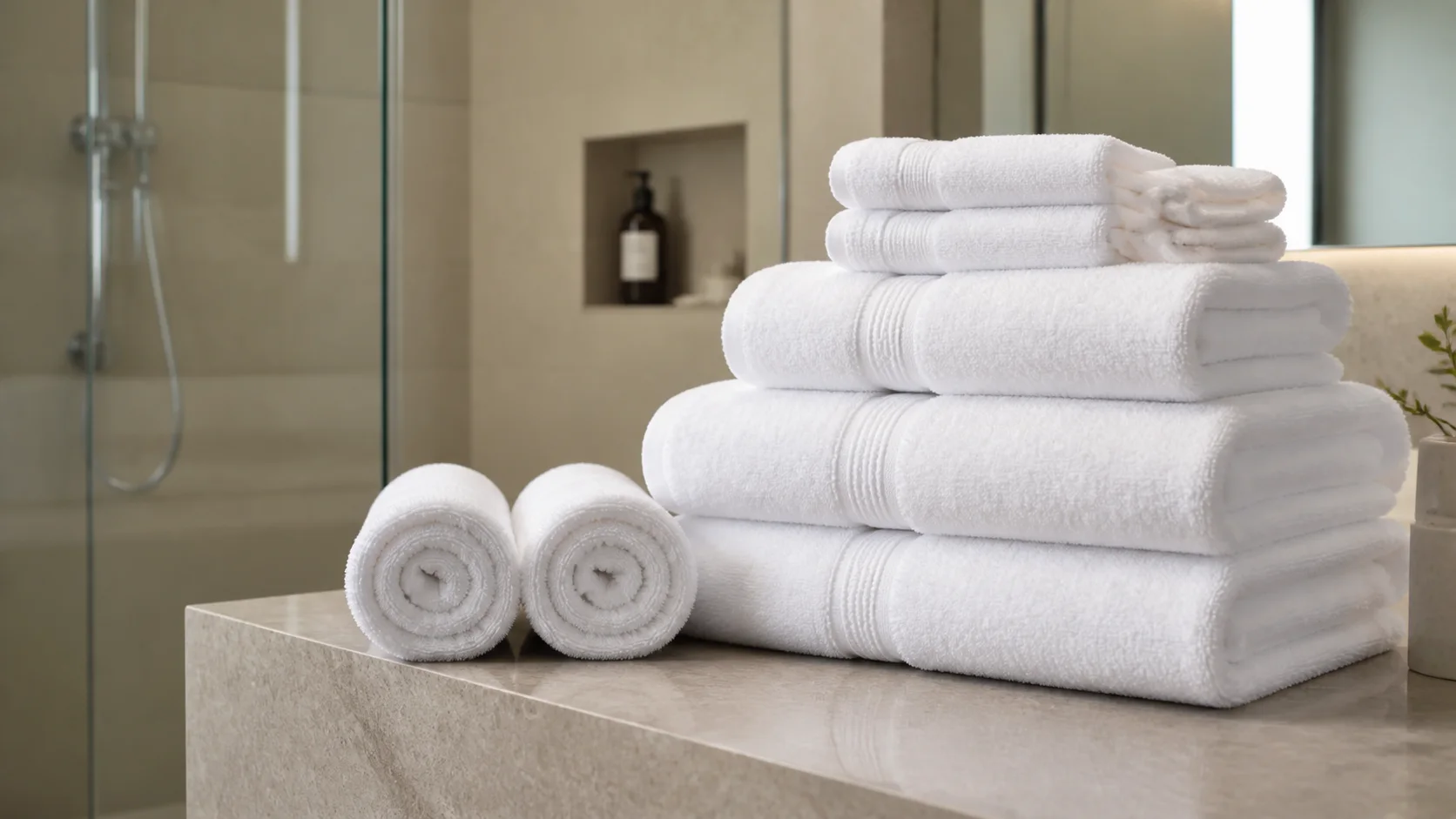
Product detail and back-of-house context help connect each specification choice to how the item looks, launders, stores, or survives service.
Hotel Towel Buying Guide: GSM, Cotton Grades & Durability
A towel is one of the few hotel textiles a guest physically wraps around themselves. A thin, scratchy, or quickly-faded one will undo an otherwise excellent room. The hard part for a procurement team is buying towels that feel premium on day one and still hold up after hundreds of industrial wash cycles. That trade-off comes down to two specs almost entirely: GSM and cotton construction.
This guide covers what hotel towels GSM actually means, the right GSM ranges by towel type and property tier, the cotton grades worth paying for, and the construction and finishing details that decide how long your towels survive a commercial laundry.
Key takeaways
- GSM (grams per square meter) measures a towel’s weight and density. Higher GSM generally means more absorbent, plusher, and more durable, but slower to dry and more costly to launder.
- Typical industry ranges: economy properties buy roughly 400-500 GSM, midscale 500-600 GSM, and upscale or luxury 600-700+ GSM bath towels. These are practical norms, not hard rules.
- Cotton grade matters as much as weight. Combed and ring-spun cotton resist linting and pilling. Zero-twist and low-twist yarns boost softness and absorbency. Long-staple (“Egyptian-type”) cotton adds strength and a finer hand.
- Durability is a system. Loop pile density, yarn quality, hemming, and dye or finish together decide whether a towel lasts 200 washes or 500.
- Match GSM to the job, not to prestige. Pool, gym, and spa towels want different weights than guestroom bath towels.
What GSM means for hotel towels
GSM stands for grams per square meter: the weight of one square meter of the towel fabric. It’s the single most useful number on a towel spec sheet because it tracks how much cotton yarn is packed into the pile.
A higher GSM towel has more loops, or longer ones, which means:
- More absorbency, since there’s more cotton surface area to wick water.
- A plusher hand, the “thick hotel towel” feel guests associate with quality.
- Greater durability, because denser pile resists wear and holds shape over many washes.
But higher GSM isn’t automatically better for every job. Heavier towels:
- Take longer to dry, on the rail and in the laundry, which raises drying energy cost and slows par-stock turnaround.
- Cost more per piece and weigh more to ship.
- Soak up more chemicals and water in the wash, adding to laundry load and processing time.
You want the right GSM for each towel’s job, not the highest number you can buy.
Recommended GSM ranges by property tier
The ranges below reflect typical hospitality norms. Treat them as a starting point and adjust for your laundry capabilities, climate, and brand standard.
- Economy / budget (≈400-500 GSM): Lightweight, fast-drying, lower cost per wash. Fine for high-turnover budget rooms where laundry efficiency matters more than plushness.
- Midscale / upscale select-service (≈500-600 GSM): The workhorse range. It balances a respectable hand-feel with manageable drying times and laundry cost.
- Upscale / full-service (≈600-650 GSM): Noticeably plush and absorbent. This is the level most guests register as “good hotel towels.”
- Luxury / resort / spa (≈650-700+ GSM): Maximum plushness and a clear premium feel. Pair these with strong drying capacity, because they’re slow to dry.
One practical tip: don’t run one GSM across every towel type. A 700 GSM bath mat makes sense. A 700 GSM washcloth is overkill that dries slowly and wastes cotton.
GSM by towel type: comparison table
Different towel types do different jobs, so their ideal weights differ too. Use this towel-type by GSM by use-case table as a procurement reference.
| Towel type | Typical size (in / cm) | Typical GSM range | Primary use-case & notes |
|---|---|---|---|
| Washcloth / face cloth | 12×12 in (30×30 cm) | 400-600 | Face and hands; high replacement rate, so durability and stain resistance matter more than plushness |
| Hand towel | 16×30 in (40×75 cm) | 400-600 | Vanity and sink use; high-touch, launder-often item |
| Bath towel | 27×54 in (70×140 cm) | 500-700+ | The guest’s main towel; the piece that most signals quality |
| Bath sheet | 35×70 in (90×180 cm) | 600-700+ | Oversized luxury option; higher GSM justified for upscale or resort rooms |
| Bath mat | 20×30 in (50×80 cm) | 700-1,000 | Stands on floor; needs heavy weight and density for absorbency and stability |
| Pool / beach towel | 30×60 in (75×150 cm) | 400-550 | Outdoor and chlorine exposure; lighter weight dries faster, often colored or striped |
| Gym / spa towel | 16×28 in (40×70 cm) | 450-600 | Frequent washing; balance softness with fast drying and durability |
Sizes vary by region and supplier, so confirm exact dimensions on your spec sheet. “Bath towel” can mean very different things from one vendor to the next.
Cotton grades: what you’re actually paying for
GSM tells you weight. Cotton grade and yarn construction tell you quality. Two towels at the same GSM can feel and wear completely differently depending on the yarn.
- Combed cotton: The fibers are combed to strip out short strands and impurities before spinning, giving a smoother, stronger, lower-linting yarn. Treat it as a near-baseline expectation for hotel-grade towels.
- Ring-spun cotton: Fibers are twisted and thinned into a fine, strong yarn. Ring-spun towels are softer and more durable than standard open-end spun towels, and they resist pilling well.
- Long-staple / “Egyptian-type” cotton: Longer fibers mean fewer loose ends, which produces stronger, finer, more lustrous yarn with a premium hand. Genuine Egyptian cotton commands a premium, and many “Egyptian-style” towels use comparable long-staple cotton from other regions. Verify origin claims with your supplier.
- Zero-twist cotton: The pile yarn is spun with essentially no twist, so the loops bloom open. That makes towels exceptionally soft and absorbent, and lighter for a given plushness. The catch: very low-twist loops can be slightly less abrasion-resistant under heavy commercial laundering.
- Low-twist cotton: A middle ground. You get much of the softness and absorbency of zero-twist with better long-term durability. It’s often the smart choice for upscale properties that want plushness and laundry survivability both.
For most hotels, combed ring-spun cotton is the dependable default. Save zero-twist and long-staple constructions for upscale and spa programs where the guest experience justifies the cost and the laundry is well-managed.
Construction details that decide durability
Weight and fiber set the ceiling. Construction determines whether a towel reaches it.
Loop pile (terry) construction
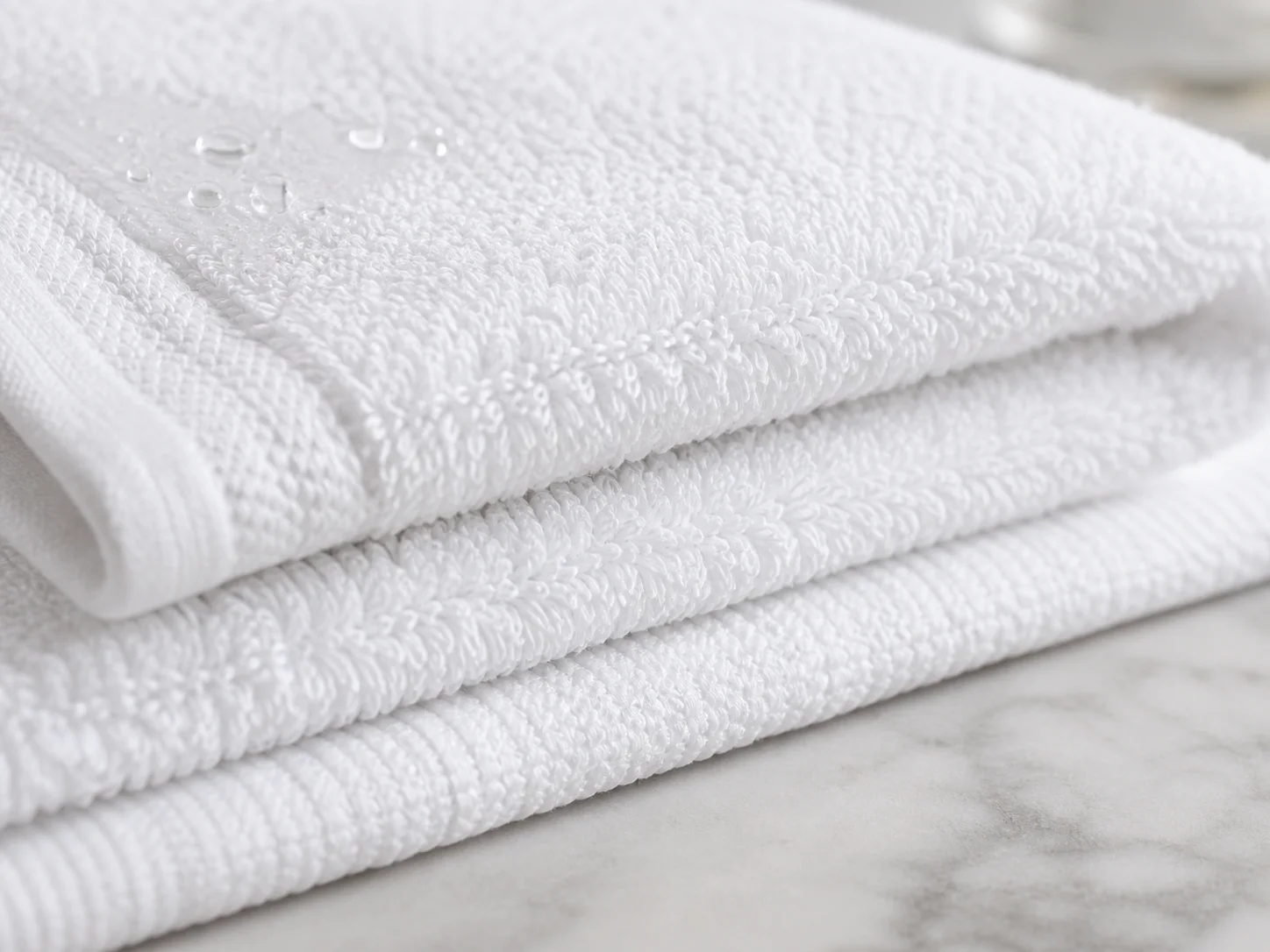
Hotel towels are terry cloth, woven with raised loops on both faces. Denser, well-anchored loops absorb more and resist snagging. Loop height matters too: taller loops feel plusher but snag and flatten faster, while shorter, denser loops give up a little plushness for longevity. The strength of the ground weave that anchors those loops is what keeps a towel from shedding after repeated washing.
Dobby border and hemmed edges
Most quality hotel towels carry a dobby border, a flat woven band near each end. Beyond looks, the dobby and a properly double-stitched, locked hem reinforce the towel’s most failure-prone areas. Weak hems are the number-one cause of premature towel retirement, so inspect stitching density and edge finishing on any sample.
Selvage and edge finishing
Clean, reinforced side edges (selvage) prevent fraying. On samples, tug the edges and look for loose threads or thin spots. They tell you how the towel will look after 100 industrial washes.
Absorbency vs durability: the core trade-off
These two pull in opposite directions, and good procurement is about balancing them.
- Maximizing absorbency favors higher GSM, taller loops, and zero- or low-twist yarn. Plush and thirsty, but slower-drying and, for very low-twist, potentially shorter-lived under heavy laundering.
- Maximizing durability favors combed ring-spun yarn, denser short loops, robust hems, and a strong ground weave. Long-lasting, but a marginally firmer hand.
The right balance depends on segment. A luxury spa leans toward absorbency and plushness. A high-volume convention hotel leans toward durability and fast drying to keep par stock cycling.
Color, whiteness, and finishing
Most hotel towels are white. It simplifies laundering, since towels can be bleached and washed hot together, and it reads as clean and premium.
- Optical brighteners make white towels look brighter, but they fade with repeated washing and harsh chemistry. Quality white towels rely on proper bleaching and a stable base white rather than leaning on brighteners.
- Colorfastness is critical for any colored pool, spa, or accent towels. Demand strong wash- and chlorine-fastness ratings, or colored towels will fade and bleed in commercial laundering.
- Shrinkage: All cotton towels shrink somewhat on the first washes, typically a few percent. Reputable suppliers pre-shrink or account for it so the delivered towel meets its labeled finished size. Always confirm whether quoted dimensions are pre-wash or post-wash.
- Absorbency finishing: Brand-new towels are sometimes less absorbent because of residual processing oils or softeners, and absorbency improves after the first few washes. Test absorbency on a laundered sample, not straight from the packaging.
Commercial laundry survivability
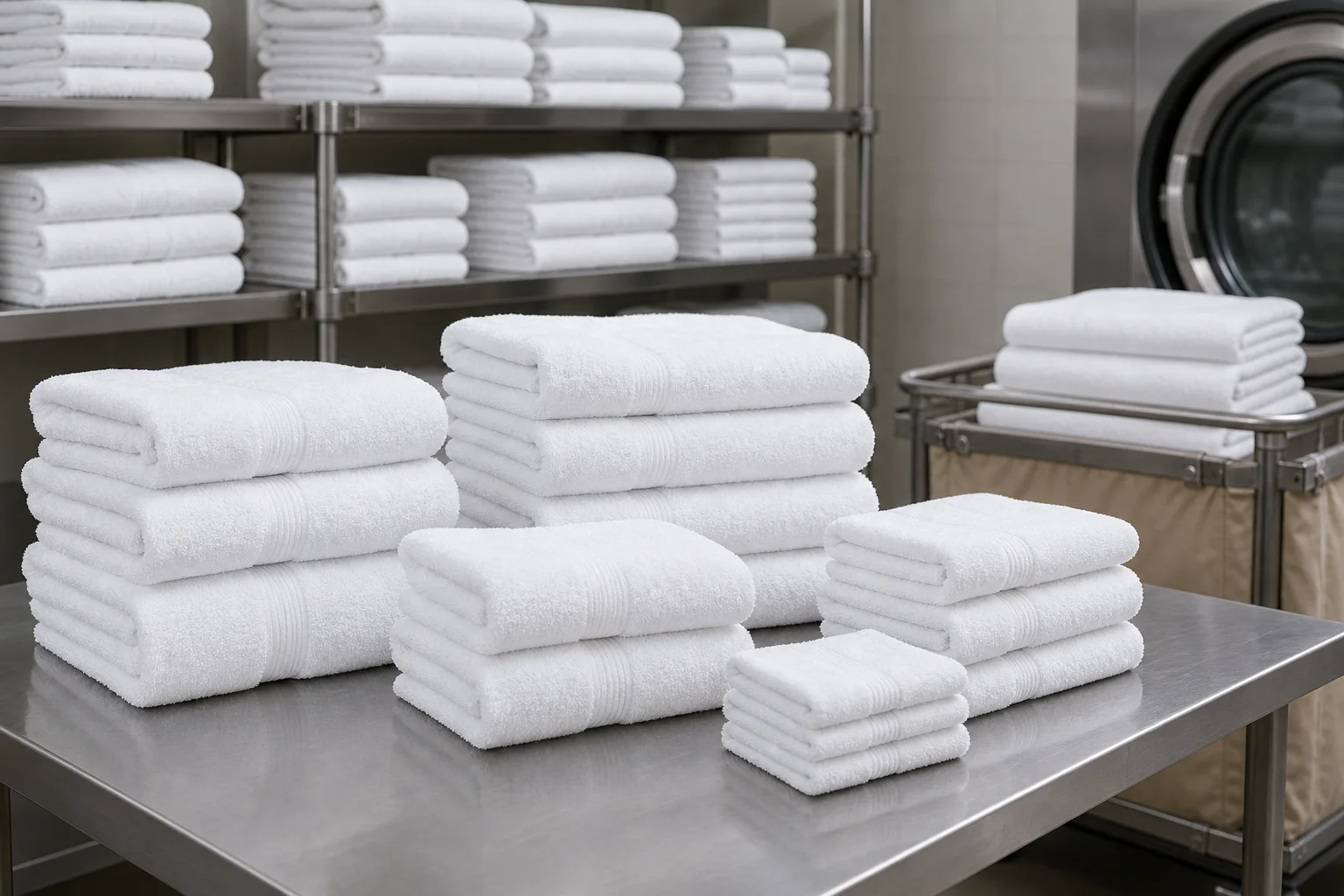
A hotel towel’s real test is the industrial laundry: hot water, strong detergents, bleach or oxidizers, high-speed extraction, and high-heat tumble drying, over and over.
- Wash-cycle expectations: Well-made combed or ring-spun hotel towels are commonly expected to withstand on the order of 200-500+ commercial wash cycles while staying presentable. Lighter or lower-grade towels sit at the low end. Premium constructions with strong hems and dense pile reach the higher end. Treat any “wash count” claim as a planning estimate, not a guarantee. Your water chemistry, dosing, and drying temperatures heavily influence real lifespan.
- What kills towels early: over-bleaching, over-drying at excessive heat, mechanical overloading, and weak hems that unravel.
- Buy in for replacement, not perpetuity. Even the best towels are consumables. Plan par stock and replacement budgets around realistic wash-life rather than expecting towels to last forever.
When you evaluate samples, ask the supplier for their tested wash-cycle range, and request a laundered sample so you can judge how the towel actually looks after processing.
A practical buying checklist
- Set GSM by towel type and tier using the table above, not one weight for everything.
- Specify yarn: combed ring-spun as the baseline, low-twist or long-staple for premium lines.
- Inspect hems and dobby borders on physical samples. This is where towels fail first.
- Confirm pre- vs post-wash dimensions and expected shrinkage.
- Request wash-fastness and colorfastness data for any colored towels.
- Test a laundered sample for absorbency, hand-feel, and edge integrity.
- Order samples before committing to a full program.
Frequently asked questions
What GSM is best for hotel bath towels?
Most hotels land between 500 and 700 GSM for bath towels. Midscale properties typically pick 500-600 GSM for a balance of feel and laundry efficiency, while upscale and luxury hotels go for 600-700+ GSM for a plusher, more absorbent towel. Higher isn’t always better, since heavier towels dry slower and cost more to launder.
Is higher GSM always better for towels?
No. Higher GSM means more plushness, absorbency, and durability, but also slower drying, higher cost, and heavier laundry loads. The best choice matches GSM to the towel’s job. A bath mat benefits from very high GSM, while a pool towel performs better at a lighter, faster-drying weight.
What’s the difference between combed and ring-spun cotton towels?
Combed cotton has had its short fibers removed for a smoother, lower-linting yarn, while ring-spun describes how the yarn is twisted into a fine, strong thread. They aren’t mutually exclusive. Combed ring-spun cotton combines both and is the dependable standard for hotel-grade towels.
How many washes should commercial hotel towels last?
Quality combed ring-spun hotel towels are generally expected to withstand roughly 200-500+ commercial wash cycles while staying presentable. Actual lifespan depends heavily on laundry chemistry, water temperature, drying heat, and hem strength, so treat wash counts as planning estimates.
Why do new hotel towels feel less absorbent at first?
New towels often carry residual processing oils or softeners that reduce absorbency. After the first few wash cycles these wash out and absorbency improves, which is why you should always test absorbency on a laundered sample rather than a brand-new one.
Are zero-twist towels good for hotels?
Zero-twist towels are exceptionally soft and absorbent, which makes them attractive for spa and luxury programs. The catch is that very low-twist loops can wear faster under heavy commercial laundering, so many properties prefer low-twist towels for a balance of plushness and durability.
Internal links: hotel-bathrobe-guide, hotel-linen-par-stock-guide, hotel-textile-certifications-explained
Building or refreshing your bathroom linen program? Request fabric samples, a full product catalog, or a custom quote from a one-stop hospitality supplies supplier to compare GSM, cotton grades, and construction in hand before you commit. The right towel spec is easiest to confirm with a laundered sample on your desk.